
Liechtenstein Käsknöpfle: cheese dumplings with caramelized onion
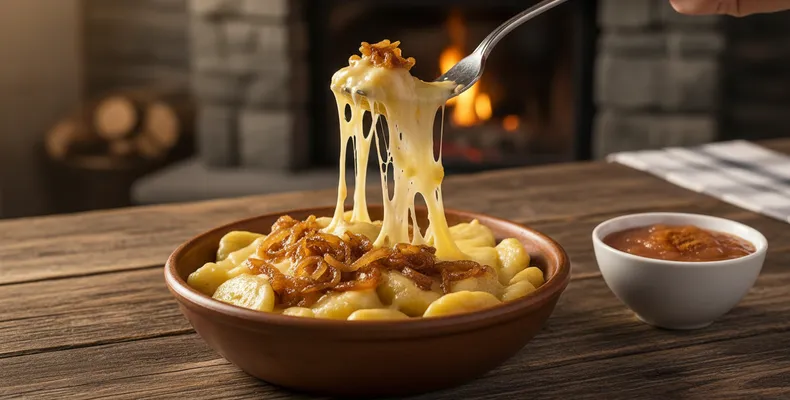
If there is one dish that represents the soul of Liechtenstein, it is Käsknöpfle. This small principality wedged between Switzerland and Austria, in the Alps, has its most beloved recipe in melted cheese and soft dough. Käsknöpfle is basically a rustic little dumpling, made from a soft batter that drips through a coarse sieve straight into boiling water, then mixed with plenty of cheese and finished with caramelized onion on top. It is comfort food in the purest sense of the word.
The name comes from German: "Käse" means cheese and "Knöpfle" means little buttons, a reference to the small, irregular shape of the cooked dough. It is a direct cousin of Austrian and German Spätzle, but in Liechtenstein and the neighboring Vorarlberg region it gained its own identity by being combined with strong-flavored Alpine cheeses such as Bergkäse and Sauerkäse. Every family has its version, and the dish appears both in everyday life and at feasts and national celebrations.
Historically, Käsknöpfle was mountain food: simple, cheap and nourishing ingredients that warmed farmers and shepherds through the harsh Alpine winters. Flour, eggs, water and the cheese produced on the Alpine farms themselves were all that was needed. Over time, the dish went from mere sustenance to a symbol of identity, served with pride as one of the country's national dishes.
The best part is that you can reproduce this Alpine delight at home without special equipment. You do not need a Spätzle maker: a sieve with large holes or a colander will do. The result is a comforting, creamy dish full of flavor, perfect for cold days or for when you crave something cozy.
Recipe card
- Origin: Liechtenstein
- Region/tradition: Alpine (Liechtenstein and Vorarlberg)
- Category: Main course
- Difficulty: Medium
- Prep time: 50 minutes
- Serves: 4
Ingredients — dough
- 3 cups all-purpose flour
- 3 eggs
- 1 cup warm water
- 1 teaspoon salt
- 1 pinch grated nutmeg
Ingredients — to assemble
- 300 g grated Alpine cheese (Bergkäse, Gruyère or Emmental)
- 2 large onions, thinly sliced
- 3 tablespoons butter
- 1 pinch salt
- 1 pinch black pepper
Method
- In a large bowl, mix the flour, salt and nutmeg.
- Make a well in the center, add the eggs and the warm water gradually.
- Beat the batter vigorously with a wooden spoon until smooth, soft and bubbly.
- Let the batter rest for 15 minutes.
- Bring a large pot of well-salted water to a boil.
- Place the batter on a sieve with large holes resting on the pot and press with a spatula so the drops fall into the boiling water.
- Cook until the dumplings rise to the surface, about 2 minutes.
- Remove with a slotted spoon and set aside, repeating until the batter is used up.
- In a skillet, melt the butter and cook the onions over low heat until golden and caramelized, stirring occasionally.
- In a pot or serving dish, make layers alternating the dumplings with the grated cheese.
- Stir gently while the cheese melts, forming an enveloping cream.
- Serve very hot with the caramelized onion on top.
Tips and variations
- The batter should be soft and sticky, thicker than pancake batter; if it is too firm, add a little more warm water.
- If you do not have a sieve with large holes, use a pasta colander or a wet board to cut strips straight into the water.
- Mix different cheeses for a more complex flavor: a milder one to melt and a stronger one for character.
- Do not cook the onions over high heat: the secret is to caramelize slowly so they turn sweet and golden without burning.
- Serve Käsknöpfle with a green salad or apple sauce, as is tradition in the Alpine region.
- For a richer version, add cream when mixing the cheese with the dumplings.
- Keep leftovers in the fridge for up to 2 days in a sealed container and reheat over low heat with a little butter.
- You can freeze just the cooked dumplings for up to 1 month and assemble the dish when serving.
A nice curiosity: in Liechtenstein and Vorarlberg, they say the quality of a Käsknöpfle is measured by the cheese "string": the more the melted cheese stretches when you lift the fork, the better made the dish. How about making it at home and testing your own cheese string? Make it, call the people you love to the table and travel to the Alps without leaving the kitchen.