
Traditional Bolivian salteñas: the baked empanadas with a juicy filling of beef, potato and peas
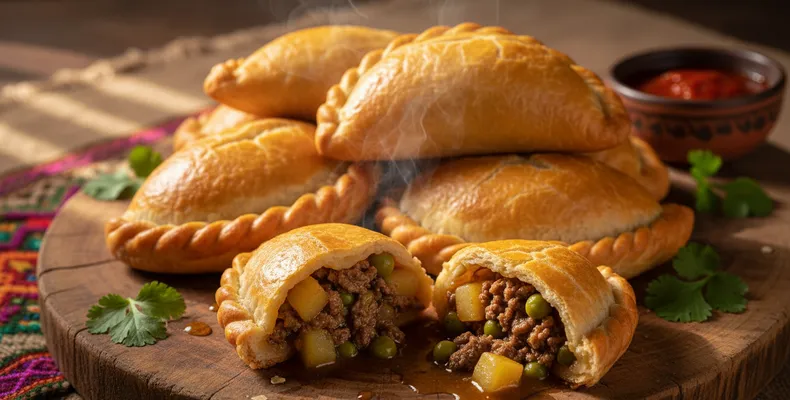
The salteña is the Bolivian morning empanada. It is sold from 9 to 12, and whoever arrives later finds the trays empty. It is eaten standing up, biting one end and sipping the broth so as not to stain your shirt, and there are even contests for eating one without spilling a drop.
The name is misleading: although salteña means a native of Salta, Argentina, the recipe is Bolivian. Tradition says that Juana Manuela Gorriti, an Argentine writer exiled in Potosí in the early 19th century, began selling them to support her family, and people came to call the empanadas by the nickname of the girl from Salta.
The magic is in the filling, the jigote: a stew of meat and vegetables thickened with gelatin that goes into the fridge, sets, is sealed inside the dough and, in the oven, turns back into broth. The dough has annatto, which gives the golden color, and a little sugar, which contrasts with the spicy filling.
Recipe card
- Origin: Bolivia, La Paz and Sucre
- Category: Baked pastry, morning snack
- Difficulty: Hard
- Preparation time: 1 hour (plus one night in the fridge for the filling)
- Oven time: 20 minutes per batch, 40 in total
- Yield: 16 salteñas
Ingredients — filling (jigote)
- 500 g beef (top round) in small cubes
- 2 medium potatoes, cooked, in small cubes
- 1 cup cooked peas
- 1 large onion, chopped
- 2 tablespoons oil
- 2 tablespoons yellow ají paste (or 1 hot paprika)
- 1 teaspoon ground cumin
- 1 teaspoon oregano
- 2 cups beef stock
- 1 tablespoon sugar
- 2 tablespoons unflavored powdered gelatin
- 1/4 cup chopped parsley
- 3 hard-boiled eggs in pieces
- 16 black olives
- 1/4 cup raisins (optional)
- Salt and black pepper to taste
Ingredients — dough
- 4 cups all-purpose flour
- 150 g butter or lard
- 2 tablespoons sugar
- 1 teaspoon salt
- 1 teaspoon annatto powder
- 2 egg yolks
- 3/4 cup warm water
- 1 beaten egg yolk for brushing
Method
- Sauté the onion in the oil until soft, add the ají paste, cumin and oregano and cook for 1 minute.
- Add the meat, sugar, salt and pepper and cook for 5 minutes, stirring.
- Add the stock and simmer over low heat for 20 minutes, until the meat is tender.
- Hydrate the gelatin in half a cup of cold water, dissolve it in the still-hot stew and mix.
- Add the potato, peas, parsley and raisins, transfer to a dish and refrigerate overnight, until it sets like a jelly.
- For the dough, melt the butter with the annatto, let it cool a little and mix with the flour, sugar, salt, yolks and water into a smooth dough. Rest 30 minutes covered.
- Divide the dough into 16 balls and roll each into a 12 cm disc.
- Place a portion of the firm filling, a piece of egg and an olive in the center, fold into a half-moon with the seam on top and braid the edge by pinching with your fingers.
- Brush with yolk and bake in a very hot oven, 230 °C (450 °F), for 15 to 20 minutes, until golden.
- Serve warm, carefully: the broth is boiling inside.
Tips and variations
- The seam goes on top, like a crest, not on the side: that is the shape that identifies the salteña.
- A very hot oven is essential so the dough seals before the broth melts and leaks.
- Chicken salteñas follow the same recipe with cubed breast instead of beef.
- They can be assembled and frozen raw; bake straight from the freezer with 5 extra minutes.
- The color can come from sweet paprika if you have no annatto.
- A llajua chili sauce, tomato with locoto chili and quirquiña, accompanies them all over Bolivia.
- If the filling does not set, add another spoonful of dissolved gelatin and return to the fridge.
Biting into a hot salteña and sipping the broth without spilling is a Bolivian art. Make them at home and practice, with a napkin nearby.