
Traditional British fish and chips: beer-battered fish with twice-fried chips
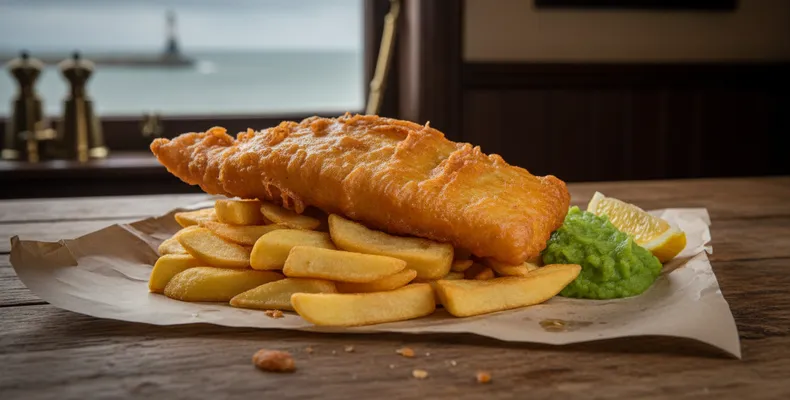
Fried fish and chips arrived in England by different routes: the battered fish with Sephardic Jews from Portugal and Spain in the 17th century, and the fried potato probably from Belgium or France. It was in the mid-19th century, with industrialization, the railways and trawl fishing in the North Sea, that the two came together in the same shop, and fish and chips became the cheap hot food of the working class.
During the Second World War it was one of the few foods never rationed, such was its importance to the country's morale. Today there are more than ten thousand chippies across the United Kingdom, and Friday fish and chips remains a ritual.
At home, the result depends on three details: cold, fluffy beer batter, very hot oil and potatoes fried twice, first at low temperature to cook, then high to brown. The mushy peas are the side from the north of England and are worth it.
Recipe card
- Origin: England, United Kingdom
- Category: Main course, fried
- Difficulty: Medium
- Preparation time: 30 minutes
- Cooking time: 40 minutes
- Yield: 4 servings
Ingredients — fish and batter
- 4 thick fillets of fresh cod, haddock or other firm white fish (180 g each)
- 1 1/2 cups all-purpose flour, plus a little for dusting
- 1/2 cup cornstarch
- 1 teaspoon baking powder
- 1 teaspoon salt
- 330 ml very cold lager
- Oil for deep frying
Ingredients — chips and peas
- 1 kg large potatoes in thick 1.5 cm batons
- 300 g peas (frozen work)
- 1 tablespoon butter
- Chopped mint, salt and pepper to taste
- Malt vinegar and coarse salt to serve
- Lemon wedges
Method
- Soak the cut potatoes in cold water for 20 minutes, drain and dry very well.
- Heat the oil to 140 °C (285 °F) and fry the chips in batches for 6 minutes, until soft and pale. Drain and set aside.
- Cook the peas in salted water for 5 minutes, drain, mash coarsely with the butter, mint, salt and pepper and keep warm.
- Mix the flour, cornstarch, baking powder and salt in a bowl. Add the cold beer all at once and stir quickly with a fork; the batter should be lumpy, not smooth. Use immediately.
- Raise the oil to 185 °C (365 °F). Dry the fillets, season with salt and dust with the extra flour, shaking off the excess.
- Dip each fillet in the batter, let it drip for a moment and lower it into the oil holding it by the tip for a few seconds before letting go, so it does not stick to the bottom.
- Fry 2 fillets at a time, for 6 to 8 minutes, turning halfway, until the crust is golden and crisp. Drain on a rack.
- Return the chips to the oil at 185 °C for 3 to 4 minutes, until golden and crisp. Drain and salt.
- Serve the fish over the chips with the mushy peas, the lemon, and malt vinegar and coarse salt to taste.
Tips and variations
- The batter must stay cold until the instant of frying: the shock with the hot oil is what makes it airy.
- Without a thermometer, a cube of bread should brown in 30 seconds at 185 °C.
- Floury potatoes (russet, maris piper) make better chips than waxy ones.
- Sparkling water instead of beer works for an alcohol-free version.
- Homemade tartar sauce (mayonnaise, pickles, capers and chives) is the other classic side.
- Fry little at a time: too much fish at once drops the oil temperature and the crust goes soggy.
- Eat immediately; fish and chips does not wait.
Crisp fish outside and moist inside, soft golden chips, vinegar and salt: it is the taste of a Friday by the sea in any English town.