
Traditional Danish smørrebrød: the open sandwiches on rye bread with herring, egg and shrimp
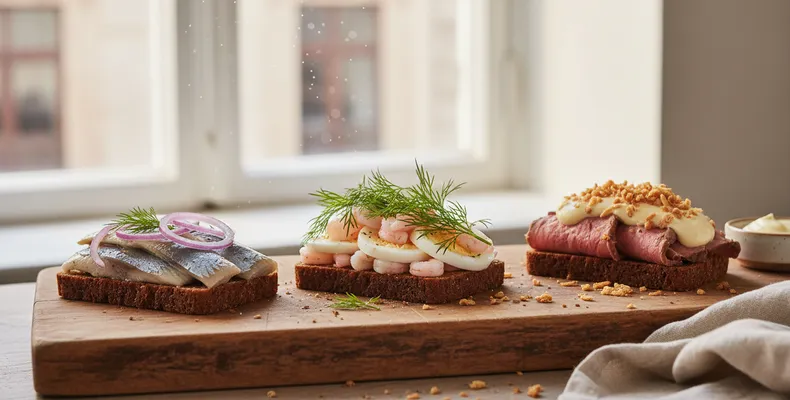
Smørrebrød means bread and butter, and it has been the base of every Danish lunch for more than two centuries. The bread is always rugbrød, the dark, dense, slightly sour rye, and the butter is mandatory: it is what keeps the bread from getting soggy under the toppings. The rest is almost endless, but there are classics every Dane recognizes from afar.
There is even an order for eating: you start with herring, move on to fish and seafood, then meats and, last, cheese. You eat with a knife and fork, never with your hands, and each smørrebrød should have height, color and a garnish that makes sense, like a twisted lemon slice, a sprig of dill or a crispy fried onion.
This recipe builds three of the most traditional: pickled herring with red onion and capers, hard-boiled egg with shrimp and dill mayonnaise, and roast beef with remoulade, crispy onions and horseradish. With a small glass of ice-cold aquavit and a beer, it is lunch in Copenhagen.
Recipe card
- Origin: Denmark
- Category: Open sandwich, lunch
- Difficulty: Easy
- Preparation time: 40 minutes
- Cooking time: 15 minutes
- Yield: 12 smørrebrød, 4 servings
Ingredients — base
- 12 slices dark rye bread (rugbrød or dense whole rye bread)
- 80 g butter at room temperature
Ingredients — herring
- 200 g pickled herring fillets (in vinegar)
- 1/2 red onion in very thin slices
- 1 tablespoon capers
- Fresh dill
- 4 lettuce leaves
Ingredients — egg with shrimp
- 4 hard-boiled eggs in slices
- 200 g small cooked peeled shrimp
- 4 tablespoons mayonnaise
- 1 tablespoon chopped dill
- Juice of 1/2 lemon
- 4 lemon slices
Ingredients — roast beef
- 200 g thinly sliced roast beef
- 4 tablespoons remoulade or mayonnaise with pickles and mustard
- 1/2 cup crispy fried onions
- 2 tablespoons grated horseradish (or prepared horseradish)
- 4 slices pickled cucumber
Method
- Butter all the bread slices generously, right to the edges.
- For the herring: put a lettuce leaf on 4 slices, arrange the pieces of herring on top, scatter the red onion slices and capers and garnish with dill.
- For the egg with shrimp: mix the mayonnaise with the chopped dill and lemon juice. Cover 4 more slices with overlapping egg slices, distribute the shrimp on top, add a spoonful of the mayonnaise and garnish with a twisted lemon slice and a sprig of dill.
- For the roast beef: cover the remaining 4 slices with the beef in folds, put a spoonful of remoulade in the center, the horseradish on top, the crispy onions and the pickle on the slant.
- Arrange the smørrebrød on a board, from fish to meat, and serve with a knife and fork.
Tips and variations
- The butter has to go right to the edge: it is what lets the bread hold the moist toppings.
- Herring in curry sauce, with egg and onion, is another classic of the Easter and Christmas table.
- Pork liver pâté (leverpostej) with bacon and mushrooms is the bar version.
- Smoked salmon with horseradish cream and watercress works well on the same bread.
- Cut each piece in half to serve at a party.
- Without Danish rye bread, choose the densest, darkest whole rye you can find; sliced white bread cannot hold the sandwich.
- Ice-cold aquavit and lager beer are the traditional companions.
Smørrebrød is a lunch that is beautiful to look at and slow to eat, from herring to roast beef, with a knife and fork and good conversation. It is Denmark at the midday table.