
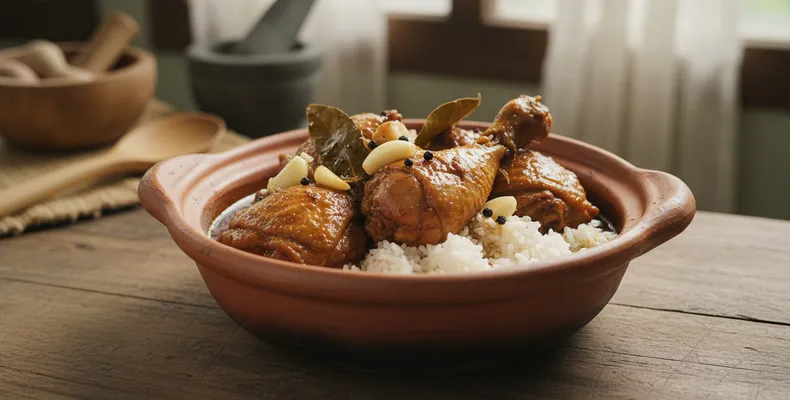
Traditional Filipino chicken adobo: the national dish cooked in vinegar, soy sauce, garlic and bay leaf
Adobo existed in the Philippines before the Spanish: cooking meat in vinegar and salt was the way to preserve it in the tropical climate, without refrigeration. The colonizers gave it the name, from adobar, to marinate, and soy sauce arrived with Chinese traders. The result is a dish every family makes its own way, and the answer to any question about what the Filipino national food is.
There is no official recipe. There is white adobo with vinegar only, adobo with coconut milk, pork adobo, squid adobo, water spinach adobo. The most common is chicken, or chicken with pork, cooked in cane vinegar, soy sauce, a whole head of garlic, black peppercorns and bay leaves, until the liquid becomes a dark, glossy sauce.
There is a rule every Filipino grandmother teaches: when the vinegar goes in, do not stir until it boils, or the raw taste stays in the dish. And another: adobo is better the next day, and better still on the third. With white rice, it is lunch from Monday to Sunday.
Recipe card
- Origin: Philippines
- Category: Main course, braised chicken
- Difficulty: Easy
- Preparation time: 15 minutes (plus 30 minutes of marinating)
- Cooking time: 50 minutes
- Serves: 4
Ingredients
- 1.2 kg chicken thighs and drumsticks, skin-on and bone-in
- 1/2 cup soy sauce
- 1/2 cup cane or rice vinegar (or white vinegar)
- 1 head of garlic, cloves peeled and lightly crushed
- 1 tablespoon black peppercorns
- 4 bay leaves
- 1 tablespoon brown sugar (optional)
- 1/2 cup water
- 2 tablespoons oil
- White rice to serve
- Chopped scallion to finish
Method
- Mix the chicken with the soy sauce, garlic, peppercorns and bay leaves and marinate for 30 minutes (or overnight).
- Heat the oil in a wide pan and brown the chicken pieces, skin side down, for 4 minutes per side. Set aside the garlic and marinade.
- Return the marinade to the pan with the water, sugar and garlic, cover and cook on low for 25 minutes.
- Add the vinegar and DO NOT stir: let it boil for 3 minutes without touching, so the vinegar loses its raw taste.
- Uncover and cook on medium for another 15 minutes, turning the chicken occasionally, until the sauce reduces and thickens, coating the meat.
- For a restaurant finish, remove the chicken and quickly fry it in a pan with its own fat until the skin browns, then return it to the sauce.
- Taste: adobo should be salty and sour in balance; adjust with a little vinegar or sugar.
- Serve over white rice with plenty of sauce and scallion on top.
Tips and variations
- Filipino cane vinegar is milder; with ordinary white vinegar, use a little less.
- Pork adobo: belly or shoulder in cubes, with 1 hour of cooking.
- Adobo sa gata: add 1 cup of coconut milk in the last 10 minutes.
- Hard-boiled eggs and cubed potato in the sauce are common home additions.
- The sauce thickens more with a teaspoon of dissolved starch at the end, but the traditional way is to reduce.
- Keeps 5 days in the fridge and gets better every day; freezes well.
- Leftovers shredded and fried until crispy become adobo flakes, great with rice and a fried egg for breakfast.
Adobo is salty, sour, full of garlic and simple to make, and it is the taste of home for every Filipino in the world. With white rice, it solves any day of the week.