
Traditional Hungarian goulash: the authentic gulyás of beef, paprika and potato in broth
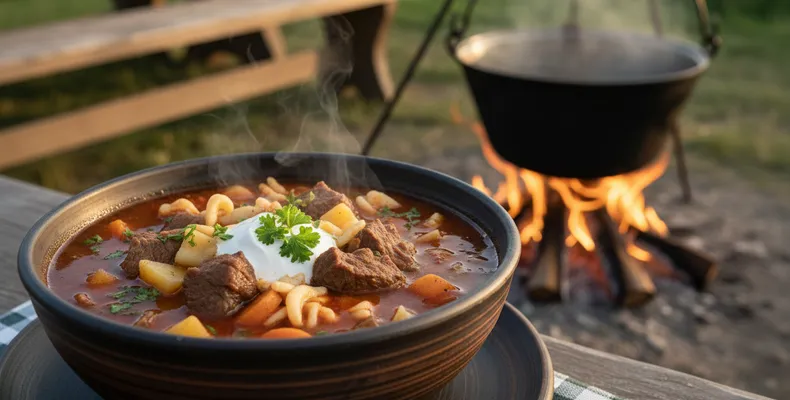
Gulyás means cattle herder in Hungarian. The herdsmen of the Great Plain carried dried meat and onion in their saddlebags and, at night, cooked everything with water in an iron cauldron hung over the fire, the bogrács. It was a soup, and it still is: the thick stew served with pasta that many countries call goulash is, in Hungary, another dish, the pörkölt.
Paprika only came in the 19th century, when the pepper brought from the Americas acclimatized in the lands of Szeged and Kalocsa and became the national seasoning. It is paprika, sweet and red, in generous quantity and never overfried, that gives color and soul to gulyás. Caraway, garlic and plenty of onion complete the picture.
The recipe asks for time, not technique: the meat cooks slowly until it falls apart, the vegetables go in later and, at the end, the hand-pinched pasta, the csipetke, cooks in the broth itself. It is served with bread and, if you like, a fresh green pepper on the side.
Recipe card
- Origin: Great Hungarian Plain
- Category: Hearty soup, main course
- Difficulty: Easy
- Preparation time: 30 minutes
- Cooking time: 2 hours 30 minutes
- Yield: 6 servings
Ingredients — soup
- 1 kg beef shank or chuck in 2 cm cubes
- 3 large onions, chopped
- 3 tablespoons lard or oil
- 3 tablespoons sweet Hungarian paprika
- 1 teaspoon caraway seeds
- 3 garlic cloves, minced
- 1 ripe tomato, chopped
- 1 green or yellow bell pepper, chopped
- 3 carrots in rounds
- 1 parsley root or 1 small turnip in cubes (optional)
- 600 g potatoes in cubes
- 2 liters water
- 1 bay leaf
- Salt and black pepper to taste
Ingredients — csipetke (pinched pasta)
- 1 egg
- 1/2 cup all-purpose flour (as needed)
- 1 pinch salt
Method
- In a large pot, melt the lard and sauté the onion over low heat for 10 minutes, until golden and soft.
- Add the meat, raise the heat and sear until it loses its raw color, stirring.
- Take the pot off the heat, add the paprika and mix well for 30 seconds; off the heat it neither burns nor turns bitter.
- Return to the heat, add the caraway, garlic, tomato, bell pepper, bay leaf, salt and pepper and a glass of water, and simmer covered over low heat for 1 hour 30 minutes, adding water little by little to keep the meat almost covered.
- Add the carrot, parsley root and the rest of the water and cook for 20 minutes.
- Add the potato and cook for another 20 minutes, until tender.
- For the csipetke, mix the egg, salt and enough flour for a firm dough. Pinch off bean-sized pieces straight into the simmering soup and cook for 5 minutes, until they float.
- Adjust the salt, remove the bay leaf and serve very hot, with bread and a fresh green pepper on the side.
Tips and variations
- Real Hungarian paprika makes a difference: regular works, Spanish smoked changes the dish.
- A spoonful of hot paprika along with the sweet gives the Szeged touch.
- Without csipetke, serve with bread or with nokedli (Hungarian spätzle).
- Better the next day; when reheating, top up with water.
- Pörkölt, the thick stew, is the same base without the water and without potato, served with nokedli and sour cream.
- Freezes very well, preferably without the potato.
- A spoonful of sour cream on top is heresy to purists and a delight to everyone else.
A deep bowl of red, steaming gulyás, with dark bread on the side, is Hungary at the table: the herdsmen's food that became the pride of an entire country.