
Traditional ugali with sukuma wiki: the Kenyan maize mash with sautéed collard greens, tomato and onion
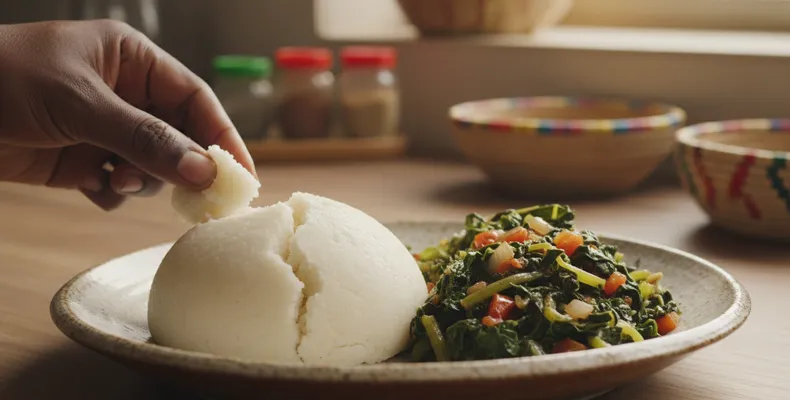
Ugali is what Kenya eats every day, at lunch and dinner, from Nairobi to the villages. It is a stiff mash of white maize flour and water, stirred with a strong wooden spoon until smooth and firm enough to be cut into pieces and used as a spoon. It goes with everything: stews, grilled meat, fish, sour milk and, in the most common version, sukuma wiki.
Sukuma wiki means push the week in Swahili: the sautéed greens that stretch the food until the next payday. It is collard greens or kale in thin strips, sautéed with onion and tomato, sometimes with a little stock or milk, and a touch of lemon. Cheap, quick and nutritious, it is the national vegetable of Kenya and Tanzania.
The ugali technique is the only thing that requires attention: the flour goes into boiling water little by little and is stirred nonstop, with force, until it becomes a mass that pulls away from the pot. A piece of nyama choma, Kenyan grilled meat, turns the pair into a feast dish.
Recipe card
- Origin: Kenya and East Africa
- Category: Side dish and everyday meal
- Difficulty: Easy
- Preparation time: 15 minutes
- Cooking time: 30 minutes
- Serves: 4
Ingredients — ugali
- 2 cups fine white maize flour (unga wa mahindi; regular cornmeal works)
- 4 cups water
- 1/2 teaspoon salt (optional; traditional ugali is unsalted)
Ingredients — sukuma wiki
- 1 large bunch collard greens (about 500 g), thick stems removed, in thin strips
- 1 large onion, chopped
- 2 ripe tomatoes, chopped
- 2 garlic cloves, chopped (optional)
- 3 tablespoons oil
- 1/2 teaspoon cumin or curry powder (optional)
- 1/4 cup water or stock
- Juice of 1/2 lemon
- Salt and black pepper to taste
Method
- For the sukuma wiki, heat the oil in a pot and sauté the onion on medium for 6 minutes, until golden.
- Add the garlic and tomato and cook for 5 minutes, until the tomato breaks down.
- Add the greens, cumin, salt and pepper and sauté for 3 minutes, stirring.
- Add the water, cover and cook on low for 8 to 10 minutes, until the greens are tender but still green. Finish with the lemon.
- For the ugali, boil the water with the salt in a thick-bottomed pot.
- Sprinkle in half the flour, stirring with a wooden spoon until it forms a lump-free porridge, and cook for 3 minutes.
- Lower the heat and add the rest of the flour little by little, stirring hard and folding the mass over itself, for 8 to 10 minutes, until firm, smooth and pulling away from the sides of the pot.
- Turn the ugali into a bowl and unmold onto the plate like a mountain. Serve with the sukuma wiki, cutting pieces of ugali by hand to pick up the greens.
Tips and variations
- Ugali at the right point does not stick to the fingers and holds its shape; if soft, cook a little longer while stirring.
- A thin-bottomed pot burns the bottom: use the heaviest one and low heat in the second stage.
- Sukuma wiki with milk: add 1/2 cup milk instead of the water for a creamier version, common in the central region.
- Spinach, chard or pumpkin leaves make the same sauté.
- Nyama choma: goat or beef ribs or leg with only salt, grilled slowly over coals, is the feast partner.
- Leftover ugali fried in slices in butter makes a great breakfast.
- Kachumbari (raw tomato, onion, cilantro and lemon) is the salad that goes with all of this.
Ugali and sukuma wiki are everyday Kenya: maize, greens, tomato and hands. A humble dish that sustains a country and teaches how to make much from almost nothing.