
Traditional Nepali momos: steamed dumplings filled with meat, onion and ginger, with tomato and sesame sauce
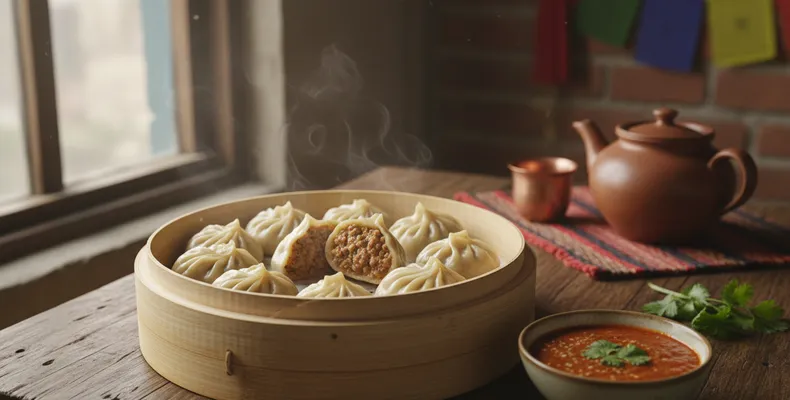
Momos came to Nepal with the Newari traders who went back and forth to Tibet along the Himalayan route, bringing Chinese dumplings back to the Kathmandu valley. There they gained more seasoning, ginger, garlic, cilantro, cumin and the tomato sauce that accompanies them, and spread across the whole country: today there is a momo stall on every corner of Nepal and in every Indian town of the Himalayan region.
The traditional filling is buffalo, the most common meat in the valley; chicken and vegetables are the most widespread versions outside it. The dough is just flour, water and salt, rolled thin, and the pleated fold, in a half-moon or a round purse, is a skill every Nepali family teaches its children. Steamed, they turn soft and moist, with the filling's juices trapped inside.
The sauce, achar, is what makes the difference: roasted or boiled tomatoes blended with toasted sesame, garlic, ginger, chili and a little timur, the Nepali Sichuan pepper, when available. It takes minutes and works with any dumpling.
Recipe card
- Origin: Nepal
- Category: Steamed dumpling, snack or main course
- Difficulty: Medium
- Preparation time: 1 hour
- Cooking time: 15 minutes
- Serves: about 40 momos, 4 portions
Ingredients — dough
- 3 cups wheat flour
- 1 cup warm water
- 1/2 teaspoon salt
- 1 tablespoon oil
Ingredients — filling
- 500 g ground meat (buffalo, beef or chicken, with a little fat)
- 1 large onion, very finely chopped
- 3 scallions, chopped
- 1 tablespoon grated ginger
- 3 garlic cloves, chopped
- 1/2 cup chopped cilantro
- 1 teaspoon ground cumin
- 1/2 teaspoon turmeric
- 1 green chili, chopped
- 2 tablespoons oil
- 1 teaspoon salt
- 1/2 teaspoon black pepper
Ingredients — sauce (achar)
- 4 ripe tomatoes
- 3 tablespoons toasted white sesame seeds
- 2 garlic cloves
- 1 piece of ginger, 2 cm
- 2 dried red chilies or 1 fresh red chili
- 1/2 teaspoon ground cumin
- 1/4 teaspoon ground Sichuan pepper (timur, optional)
- Juice of 1/2 lemon
- 2 tablespoons oil
- Salt to taste
Method
- Mix the flour and salt, add the warm water and oil little by little and knead for 8 minutes until the dough is smooth and firm. Cover and rest for 30 minutes.
- Mix all the filling ingredients by hand until uniform and slightly moist.
- For the sauce, boil the whole tomatoes in water for 5 minutes (or roast until the skin bursts), remove the skin and blend with the sesame, garlic, ginger, chili, cumin, timur, lemon, oil and salt until smooth. Adjust the salt.
- Divide the dough into 40 small balls, roll each into a thin 8 cm disc, thinner at the edges and thicker in the center.
- Place a heaping teaspoon of filling in the center. For the round purse, pleat the edge all the way around, gathering the pleats at the top and pinching to close. For the half-moon, fold in half and pleat one side only.
- Grease the steamer basket with oil and arrange the momos without touching each other.
- Steam over strong steam for 10 to 12 minutes, until the dough is glossy and translucent and the filling firm.
- Serve hot with the achar in small bowls.
Tips and variations
- Filling with a little fat stays juicy; meat that is too lean gives dry momos.
- Dough rolled too thin tears in the steam; too thick is heavy: 1 to 2 mm is the point.
- Vegetarian momos: grated cabbage, carrot, mushrooms and paneer, well squeezed.
- Kothey momos are steamed and then browned on one side in a frying pan.
- Jhol momos come submerged in a thin tomato and sesame soup, the winter dish.
- They freeze raw very well, on a tray and then in a bag; steam straight from frozen with 4 extra minutes.
- Without a steamer, use a metal sieve over a pot of water with a lid.
Hot momos with tomato and sesame sauce are the reason many people return to Nepal. Make them as a family, with everyone folding, and serve straight from the steamer basket.