
Traditional pavlova: the New Zealand meringue, crisp outside and soft inside, with whipped cream and kiwi
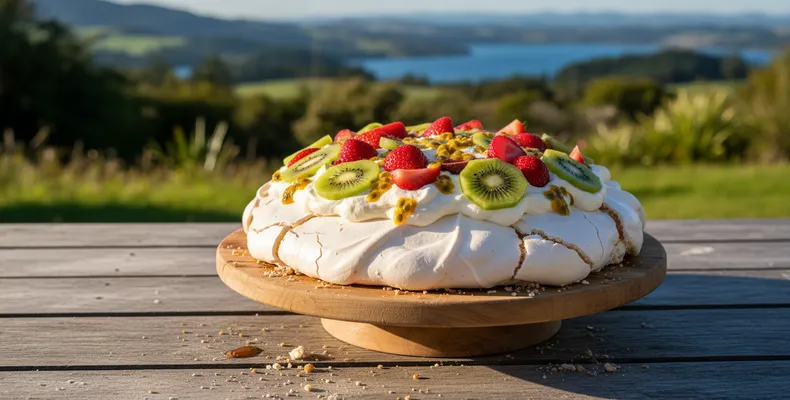
Australia and New Zealand have argued for decades over who invented the pavlova, and New Zealand has the oldest recipe: a 1929 book from Dunedin, named in honor of the Russian ballerina Anna Pavlova, who toured both countries in 1926. It is the Christmas dessert of the southern-hemisphere summer, of birthdays and of every occasion that calls for something light, beautiful and full of fruit.
Unlike dry French meringue, pavlova has a soft, almost marshmallow center, thanks to the cornstarch and vinegar in the mixture and the low oven that dries only the outside. The shell cracks a little as it cools, and that is expected: the whipped cream covers it. On top, tart fruit cuts the sweetness: kiwi, the country's symbol fruit, passion fruit, strawberry and berries.
Pavlova's enemies are humidity, grease in the bowl and haste. Egg whites at room temperature, sugar added gradually until dissolved, a low oven and the door closed until cool. With that, it comes out tall, white and crisp, and it is assembled only at serving time.
Recipe card
- Origin: New Zealand
- Category: Dessert, meringue
- Difficulty: Medium
- Preparation time: 25 minutes
- Oven time: 1 hour 30 minutes (plus 2 hours cooling in the oven)
- Serves: 8
Ingredients — meringue
- 6 egg whites at room temperature (about 200 g)
- 1 1/2 cups caster sugar (300 g)
- 2 teaspoons cornstarch
- 1 teaspoon white vinegar
- 1 teaspoon vanilla extract
- 1 pinch of salt
Ingredients — topping
- 300 ml cold heavy cream
- 1 tablespoon icing sugar
- 3 kiwis, sliced
- 1 punnet of strawberries, halved
- Pulp of 2 passion fruits
- Mint leaves
Method
- Preheat the oven to 150 °C. Draw a 22 cm circle on baking paper, turn the paper over and line a baking sheet.
- Wipe the bowl and whisk with a little vinegar to remove any grease.
- Beat the egg whites with the salt on medium speed until soft peaks form.
- Add the sugar one spoon at a time, beating constantly, and keep beating for 6 to 8 minutes after the last spoon, until the meringue is stiff, glossy and the sugar has dissolved (rub a little between your fingers: you should feel no grains).
- Sift the cornstarch over, add the vinegar and vanilla and fold in with a spatula in a few strokes.
- Spread the meringue inside the circle, about 8 cm high, smoothing the sides upward and leaving the top slightly dipped in the center.
- Place in the oven and immediately lower to 120 °C. Bake for 1 hour 30 minutes, without opening the door.
- Turn off the oven, prop the door open with a wooden spoon and let the pavlova cool inside for at least 2 hours.
- When serving, whip the cream with the sugar to stiff peaks, spread over the pavlova and top with the kiwi, strawberries, passion fruit and mint.
Tips and variations
- A rainy day is the enemy of pavlova: humidity softens the shell. If possible, bake on a dry day.
- Any trace of yolk or grease keeps the whites from rising.
- Meringue with undissolved sugar grains weeps liquid in the oven: beat longer.
- Individual mini pavlovas bake in 50 minutes.
- Berries, mango and passion fruit are the summer toppings; with grated chocolate, the winter one.
- The baked meringue keeps 2 days in a sealed container without topping; once assembled, eat right away.
- A pinch of cream of tartar instead of vinegar also stabilizes the whites.
Pavlova is New Zealand's summer in a dessert: crisp meringue, soft center, cream and tart kiwi on top. Beautiful to look at, light to eat and easier than it seems.