
Traditional mumu: Papua New Guinea's pork, sweet potato and greens cooked in the earth oven with coconut milk
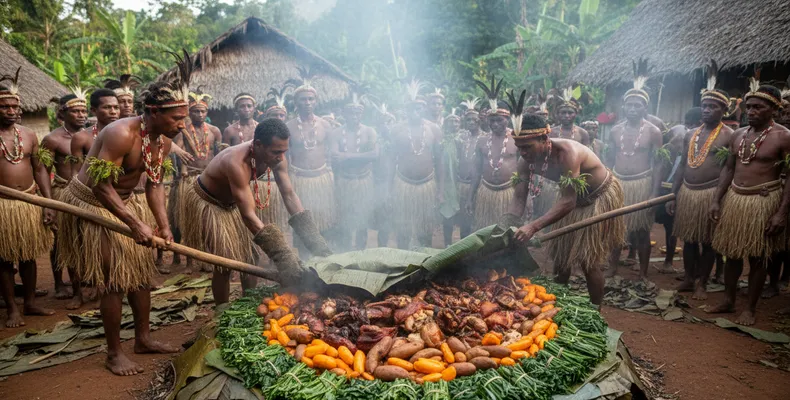
In the highlands of Papua New Guinea, no important ceremony happens without mumu: wedding, compensation between clans, funeral, the welcoming of a visitor. Pigs are the villages' greatest wealth, and a large mumu can cook dozens of them, with hundreds of kilos of sweet potato, in a pit meters long, around which the whole community works from dawn.
The technique is the earth oven of all Oceania: stones heated in a fire, placed at the bottom of the pit, covered with banana leaves, layers of meat and roots alternated with more stones and leaves, water and coconut milk poured over to make steam, and everything covered with leaves, earth and grass. After two to four hours, the pit is opened and the food is distributed on leaves, in order of the importance of those present.
At home, a lidded barbecue or an oven reproduces the essential: the slow steaming, with the pork and roots absorbing the coconut and the scent of the leaves. Sweet potato, kaukau in Tok Pisin, is the staple of the highlands and cannot be missing; pumpkin and aibika leaves, an edible hibiscus, go in at the end and can be replaced by spinach and collards.
Recipe card
- Origin: Highlands of Papua New Guinea
- Category: Feast dish, cooked in the earth oven
- Difficulty: Medium (work, not technique)
- Preparation time: 1 hour
- Cooking time: 3 hours
- Serves: 10
Ingredients
- 2 kg pork leg or shoulder with skin, in large pieces
- 1.5 kg whole sweet potatoes with skin, washed
- 6 green plantains with skin
- 500 g taro or yam in large pieces
- 1 bunch pumpkin leaves or spinach
- 1 bunch collard greens or aibika
- 2 cans coconut milk (800 ml)
- 1 tablespoon coarse salt
- 2 pieces of ginger, crushed
- Banana leaves in quantity (or aluminum foil)
- Clean river stones (if doing it on the barbecue or in a pit)
Method
- Rub the pork with the salt and ginger and let rest 30 minutes.
- Pass the banana leaves over a flame or in hot water to soften.
- On the lidded barbecue: heat stones in the coals for 1 hour until very hot and arrange half of them at the bottom of a large cast-iron pot or a metal can, covered with banana leaves. In the oven: use a deep baking dish lined with leaves.
- Build the layers: sweet potato, taro and banana at the bottom, the pork on top, more banana leaves between the layers and, if using stones, some among them.
- Pour half the coconut milk over.
- Cover with banana leaves and, on the barbecue, with wet burlap sacks and the lid; in the oven, with leaves and tightly sealed foil.
- Cook for 2 hours 30 minutes (barbecue on medium indirect heat or oven at 170 °C).
- Open, add the green leaves on top, drizzle with the rest of the coconut milk, close again and cook for another 30 minutes.
- Open at the table, over banana leaves, and serve the roots, pork and greens together, drizzled with the juices from the bottom.
Tips and variations
- The real pit: 60 cm deep, stones heated for 2 hours, layers as described, earth and grass on top, 3 to 4 hours.
- Whole chicken and fish wrapped in leaves are the other proteins of the mumu.
- The sweet potato cooks with its skin and is peeled on the plate.
- Coconut milk is from the coast; in the highlands, the traditional mumu is water only, drier.
- River stones explode if wet: use dry stones or firebricks.
- Leftover pork and sweet potato fried in a pan the next day make a good breakfast.
- Serve with salt and lime on the side and nothing else: the flavor is that of smoke and coconut.
Mumu is a village feast: pork, sweet potato and leaves steamed by the stones for hours, opened before everyone. Make it on the lidded barbecue, on a Saturday, and serve on the leaf.