
Traditional Salvadoran pupusas: the thick corn tortillas stuffed with cheese, beans and chicharrón, with curtido
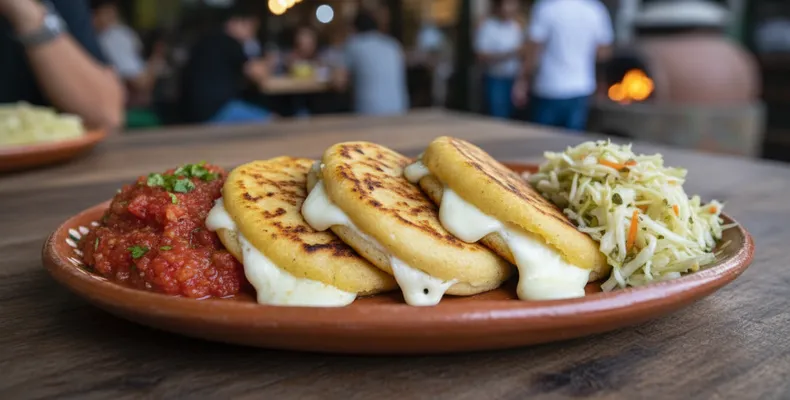
The pupusa is so Salvadoran that it has a national day, the second Sunday of November, and a law declaring it the national dish. The Pipil were already making stuffed tortillas before the Spanish, and the word comes from Nahuatl. Today pupuserías are on every corner of El Salvador and in every Salvadoran neighborhood of the United States, with women shaping the discs in their palms at a speed that impresses.
The dough is masa of nixtamalized corn, the same as for tortillas, made from instant flour with water and salt. The classic filling is cheese, which melts and runs out of the edges on the griddle; refried beans, creamy; chicharrón, pork cooked and ground with tomato; and the revuelto, which combines all three. Loroco, an edible flower, and zucchini are other popular fillings.
Without curtido it is not a pupusa: shredded cabbage with carrot, onion and oregano, pickled in vinegar for hours or days, which cuts the fat of the cheese. And the thin tomato sauce, cooked with onion and oregano, to pour over. It is eaten with the hands, tearing and dipping.
Recipe card
- Origin: El Salvador
- Category: Stuffed tortilla, main course or snack
- Difficulty: Medium
- Prep time: 40 minutes (plus the curtido the day before)
- Cooking time: 30 minutes
- Serves: 12 pupusas, 4 servings
Ingredients — curtido and sauce
- 1/2 small cabbage, thinly shredded
- 1 carrot, grated
- 1/2 onion, thinly sliced
- 1 teaspoon dried oregano
- 1/2 cup white vinegar
- 1/2 cup water
- 1 teaspoon salt
- 1 chile, chopped (optional)
- For the sauce: 4 tomatoes, 1/4 onion, 1 garlic clove, 1/2 teaspoon oregano, salt, blended and cooked for 10 minutes
Ingredients — dough and fillings
- 3 cups nixtamalized corn flour (masa harina)
- 2 1/2 cups warm water
- 1 teaspoon salt
- Oil for hands and griddle
- 300 g melting cheese (mozzarella with a little fresh white cheese), grated
- 1 cup refried mashed beans (frijoles refritos)
- 200 g chicharrón: cooked pork ground in a food processor with 1 tomato, 1/4 onion and 1/2 bell pepper (optional)
Method
- The day before, blanch the cabbage for 1 minute, drain and mix with the carrot, onion, oregano, vinegar, water, salt and chile. Keep in the fridge.
- Mix the corn flour, salt and warm water into a soft, moist dough that does not crack when pressed. Cover and rest for 15 minutes.
- Prepare the fillings: plain cheese, beans mixed with a little cheese, and chicharrón mixed with cheese (the revuelto combines all three).
- Oil your hands. Take a ball of dough the size of a lime, flatten it in your palm into an 8 cm disc and make a well in the center with your thumb.
- Put 1 heaping tablespoon of filling in the well, close the dough over it like a bundle, pressing well, and flatten again with your palms, patting from one hand to the other, into a 12 cm disc 1 cm thick.
- Heat a griddle or nonstick skillet over medium-high heat with a drizzle of oil.
- Add the pupusas and cook for 3 to 4 minutes per side, until browned in spots and the cheese starts to run.
- Serve hot with the drained curtido on top or on the side and the tomato sauce to pour over.
Tips and variations
- Dough cracking: needs water. Dough sticking: needs oil on your hands.
- Cheese leaking and burning on the griddle is a sign of a good pupusa, not a mistake.
- Rice pupusas, made with rice flour, are the specialty of Olocuilta.
- Loroco (flower) with cheese is the most Salvadoran filling; grated zucchini with cheese is the alternative.
- They can be assembled and frozen raw, separated by paper.
- Curtido improves with days in the fridge and keeps for 2 weeks.
- One pupusa of each kind per person is the pupusería portion.
Pupusa is corn, melted cheese and tangy cabbage in your hands: the food El Salvador eats every day and that teaches you, at the first bite, why it deserves a national day.