
Traditional palusami: Samoan taro leaves filled with coconut cream and onion, baked in the umu
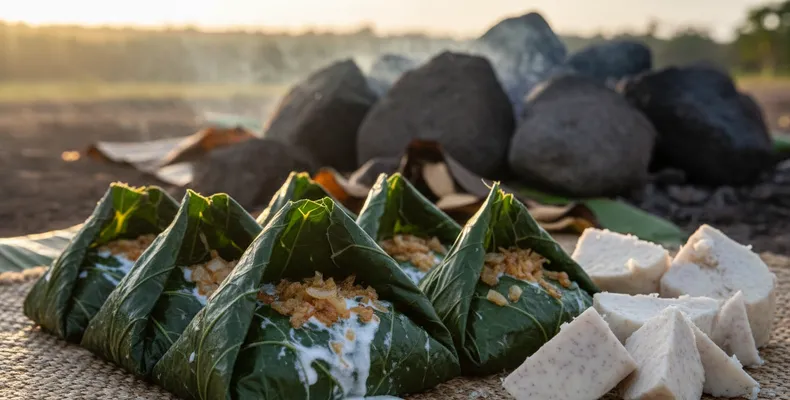
Every Sunday in Samoa, before church, the men of the family prepare the umu, the oven of heated stones on the ground of the yard. Onto the stones go taro, breadfruit, roast pork and the palusami parcels, covered with banana leaves and sacks, and everything cooks for hours in the trapped heat while the family prays. It is the toonai, the Sunday lunch, and palusami is its heart.
The recipe could not be simpler: young taro leaves, the Pacific taro, layered into a bowl shape and filled with thick coconut cream with onion and salt, wrapped in banana or breadfruit leaf and cooked until the taro leaves soften and absorb the coconut. The result is a dark green cream, sweet and salty, eaten with boiled taro or rice.
The very popular modern version has canned meat inside the coconut; the old one is just leaf and coconut. Taro leaves are found in Asian and Latin stores, fresh or frozen, and need long cooking: raw, they irritate the mouth. Spinach or large-leaf chard make a quicker, milder version.
Recipe card
- Origin: Samoa
- Category: Main course or side, greens in coconut
- Difficulty: Easy
- Preparation time: 30 minutes
- Oven time: 1 hour
- Serves: 6
Ingredients
- 30 young taro leaves (or 500 g large-leaf spinach or chard without stems)
- 400 ml thick coconut cream (the thick part of 2 cans of coconut milk, or squeezed fresh coconut)
- 1 large onion, finely chopped
- 1 1/2 teaspoons salt
- Juice of 1 lemon (optional)
- 1 can corned beef (340 g) in pieces or 300 g cooked shredded beef (optional)
- Banana leaves or aluminum foil for wrapping
- Boiled taro, breadfruit or rice to serve
Method
- Wash the taro leaves and remove the thick central rib. If using spinach or chard, wash and dry.
- Mix the coconut cream with the onion, salt and lemon.
- Preheat the oven to 180 °C. Pass the banana leaves over a flame to soften.
- In a small bowl lined with a square of banana leaf (or foil), overlap 5 or 6 taro leaves in a fan, forming a bowl.
- Place a little meat in the center, if using, and pour in about 1/3 cup of the coconut cream with onion.
- Close the taro leaves over the filling like a package, then close the banana leaf over the top and tie or wrap well in foil. Repeat for 6 parcels.
- Arrange the parcels in a deep baking dish, cover with foil and bake for 1 hour (45 minutes with spinach), until the leaves are very soft and the coconut absorbed.
- Serve the parcels closed, to open on the plate, with taro or rice.
Tips and variations
- Taro leaves require complete cooking: never taste before the time is up.
- Thick coconut cream is essential; thin coconut milk runs off and the palusami turns watery.
- In a pot, the parcels steam for 1 hour with a close result.
- Fresh fish in pieces inside the coconut is the feast version.
- A pinch of chili is a modern addition, not traditional.
- Leftovers reheat well in the oven, still wrapped.
- Serve with breadfruit roasted over coals for the complete Samoan lunch.
Palusami is leaf, coconut and onion cooked until they become one, wrapped in banana leaf: Samoa's Sunday in a package. Open it on the plate and eat with taro.