
Traditional kisra: the Sudanese fermented sorghum pancake-bread, thin and sour, with mullah stew
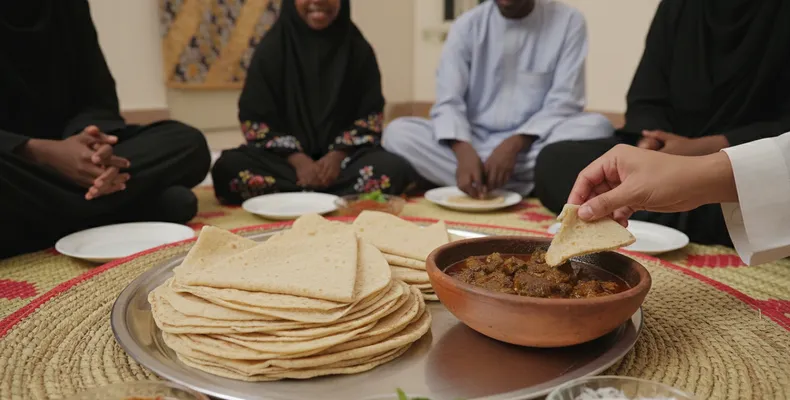
Kisra is to Sudan what injera is to Ethiopia: the fermented pancake-bread that serves as plate and cutlery, made from sorghum, the grain that grows where wheat does not. In Ethiopia teff is used; in Sudan, sorghum, called dura, and the batter ferments for a whole day in a clay pot until sour and full of bubbles.
The cook spreads the batter in a paper-thin layer over the saj, the greased iron griddle, with a quick sweep of a palm-leaf spatula, and the kisra cooks in seconds. It comes out thin as paper, flexible, slightly sour, and is folded and stacked. On top goes mullah, the Sudanese stew: dried or fresh meat cooked with onion, tomato, garlic and waika, the powdered dried okra that thickens the sauce and gives the most Sudanese flavor of all.
Sorghum flour is found in health-food and African stores; fine corn flour mixed with a little wheat makes a less sour and easier kisra. The technique in a nonstick pan takes a few tries, and then becomes routine.
Recipe card
- Origin: Sudan
- Category: Fermented bread with stew, meal
- Difficulty: Medium
- Preparation time: 30 minutes (plus 24 hours of fermentation)
- Cooking time: 1 hour
- Serves: 6 (about 20 kisras)
Ingredients — kisra
- 2 cups sorghum flour (or 1 1/2 fine cornmeal plus 1/2 wheat flour)
- 2 1/2 cups warm water
- 1 tablespoon fermented batter from a previous batch or 1/2 teaspoon dry yeast
- 1/2 teaspoon salt
- Oil for greasing
Ingredients — mullah of meat with okra
- 500 g beef in small cubes
- 2 onions, finely chopped
- 3 tablespoons oil
- 2 tablespoons tomato paste
- 2 tomatoes, chopped
- 3 garlic cloves, crushed
- 3 tablespoons dried okra powder (waika; or 200 g fresh okra, finely chopped)
- 1 teaspoon ground coriander
- 1/2 teaspoon cinnamon
- 1 liter water
- Salt and black pepper to taste
- Juice of 1/2 lemon
Method
- The day before, mix the sorghum flour, warm water, yeast and salt into a liquid, smooth batter like pancake batter. Cover and let ferment in a warm place for 18 to 24 hours, until sour and bubbly.
- For the mullah, heat the oil and brown the meat for 8 minutes. Add the onion and sauté for 5 minutes.
- Add the tomato paste and fry for 2 minutes. Add the tomato, garlic, coriander, cinnamon, salt and pepper and cook for 5 minutes.
- Pour in the water, cover and cook on low for 40 minutes, until the meat is tender.
- Dissolve the okra powder in a little water and add to the stew (or add the chopped fresh okra). Cook for 10 minutes, stirring, until thick. Finish with the lemon.
- For the kisras, heat a large nonstick pan on medium and wipe with an oiled cloth. Stir the batter and pour 1/3 cup into the center.
- With a plastic spatula or the back of a spoon, spread the batter in quick outward circles, forming a very thin layer, to the edge.
- Cook for 40 to 60 seconds, on one side only, until the surface dries and the edges release. Remove with the spatula, fold in half and stack covered with a cloth. Repeat.
- Serve the kisras on a tray with the mullah in a bowl in the center, tearing pieces of bread to scoop up the stew.
Tips and variations
- Keep a little of the fermented batter in the fridge to start the next batch: that is how it is done in Sudan.
- The first kisras usually come out thick: the batter should be very liquid and the motion quick.
- Medium heat, not high: kisra cooks fast and burns even faster.
- Mullah with dried fish, dried meat (sharmout) or vegetarian with eggplant are common.
- Dried okra powder is found in African and Arab stores; chopped fresh okra plays the part.
- Kisra keeps 2 days wrapped in a cloth; it hardens in the fridge.
- Serve with a salad of tomato, cucumber and ground peanuts, as in Sudan.
Kisra and mullah are the Sudanese meal par excellence: thin, sour sorghum bread, thick meat and okra stew, eaten by hand from a single tray. A day of fermentation and a sweep in the pan, and Sudan is at the table.